Dexscreener app is a live DEX pair dashboard for alerts and multichain watchlists
Key takeaway: Decentralized exchange charting tool for tracking token pairs, with real-time multichain watchlists across Ethereum and Solana.
Dexscreener app is a live charting workspace for DEX pairs, price alerts, and cross-chain watchlists. It gives token watchers a single screen for pair prices, liquidity, volume, transactions, market capitalization, contract details, and trending pools across networks such as Ethereum, Solana, Base, BNB Chain, Polygon, and Arbitrum. The main job is speed: find the exact pair, read its market activity, save it, and return when the chart or alert needs attention.
Pair pages turn raw pool data into a trading screen
A pair page begins with the market itself: one token against another token inside a decentralized exchange pool. On Ethereum, that might be an ERC-20 token paired with WETH or a stablecoin on Uniswap. On Solana, it might be an SPL token paired with SOL or USDC on Raydium, Orca, Meteora, or another venue. The Dexscreener app page pulls those pool-level signals into a chart view so the user does not need to inspect block explorers one transaction at a time.
The chart is useful because decentralized markets fragment liquidity. A token ticker alone does not identify the real market; the same symbol appears on several chains, several DEXs, and sometimes several unrelated contracts. Pair address, chain, liquidity depth, and recent swaps give the chart its meaning. A serious scan starts with those fields before anyone treats a candle as meaningful.
Alerts, watchlists, and trending feeds in one routine
Inside Dexscreener app, alerts turn token monitoring from constant refreshing into a rules-based routine. A user follows pairs, builds watchlists, and sets price triggers around levels that matter to the position or research process. This is especially useful for volatile Solana and Base pairs, where a move forms within minutes and social feeds lag behind the chart.
Watchlists also separate research from noise. One list might hold established pairs with deep liquidity, another might track new launches, and a third might monitor wallets or community tokens that need more observation before action. The best workflow is plain: search by contract, confirm the chain, inspect liquidity, add the pair, then set an alert that matches a specific price or percentage move.
Where Ethereum, Solana, Base, and BNB Chain data meet
Multichain coverage is the reason this tool fits daily DeFi research. Ethereum pairs show the activity around Uniswap-style automated market makers and higher-value ERC-20 markets. Solana brings fast SPL token launches and intense meme coin rotation. Base, Arbitrum, Polygon, and BNB Chain add their own fee environments, DEX ecosystems, and token discovery patterns. That breadth makes Dexscreener app useful when attention jumps from one chain to another during a market session.
Cross-chain scanning still requires discipline. A token that looks liquid on one chain might have a thinner wrapped or bridged market elsewhere. Contract addresses, pair age, and exchange venue matter because they identify which market the chart actually represents. When two charts share a name but not a contract, they are separate assets for practical research purposes.

Reading liquidity and volume before chasing a candle
Price is the easiest number to notice and the easiest number to misread. Liquidity explains how much depth stands behind the current chart. Volume shows whether the move has participation. Transaction count and buy-sell flow reveal whether activity is broad or driven by a few swaps. A sudden green candle with shallow liquidity deserves a different interpretation from a sustained move with meaningful volume across many transactions.
Useful scan points include:
- Pair age, because newly created pools carry more execution and contract risk.
- Liquidity, because thin pools produce violent slippage.
- Twenty-four-hour volume, because inactive charts make signals unreliable.
- Recent buys and sells, because order flow exposes momentum shifts.
- Contract and pair identity, because copycat tickers are common.
These fields do not predict the next candle. They give the user a cleaner view of the market being inspected, which is the practical advantage of a fast pair tracker.
Setting up the mobile app without losing your filters
Dexscreener app on a phone works best after the first ten minutes of setup. Start by searching a known token contract instead of a ticker, because contract search avoids lookalike symbols. Open the correct chain, select the active pair with the liquidity you intend to monitor, then add it to a watchlist. After that, create alerts around exact levels instead of vague interest zones.
A clean setup keeps the main screen readable. Put high-conviction pairs in one list, experimental launches in another, and chain-specific watches in separate groups. Use trending feeds for discovery, not confirmation. Discovery is where the app surfaces movement; confirmation comes from the pair page, the contract, the liquidity profile, and the trade history.
When token discovery needs more context than a price chart
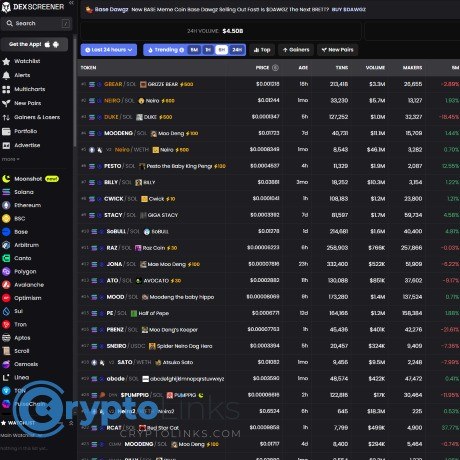
New token discovery is where this category of app receives the most attention, especially around meme coins and fast-moving community launches. The chart tells only part of the story. A stronger review looks at the pool, the number of swaps, whether liquidity has appeared recently, whether volume fades after the first burst, and whether the pair has a stable quote asset such as USDC, SOL, WETH, or WBNB.
The same screen also helps after a token is already known. A holder checks whether liquidity keeps pace with market capitalization, whether volume returns after quiet periods, and whether the pair remains active on its main chain. A researcher uses the Dexscreener app chart as a market map rather than a signal by itself.
DexTools, GeckoTerminal, Birdeye, and TradingView as companions
Alternative tools matter because no single charting surface owns every workflow. DexTools is familiar to Ethereum and EVM users who want token scoring, DEX analytics, and pair monitoring around Uniswap-style markets. GeckoTerminal covers many chains and emphasizes broad DEX pool discovery. Birdeye is especially popular for Solana token analytics, with strong wallet and token views. TradingView remains the reference for polished charting on larger listed assets, though DEX microcap coverage follows a different data model.
A Dexscreener app workflow pairs well with these tools when the user separates jobs. Use one surface for fast pair discovery, another for deeper Solana wallet context, another for broad technical charting, and a block explorer for contract-level details. That combination reduces blind spots without turning the process into a spreadsheet exercise.
Costs, limits, and the risk inside thin pools
The app itself is mainly a market information layer; the real costs appear when a user trades through a wallet or DEX route. Network fees, DEX fees, price impact, and slippage come from the blockchain and liquidity pool being used. On Solana, the network fee is usually small, while Ethereum mainnet transactions cost more during congestion. On any chain, a thin pool creates poor execution even when the chart looks active.
Treat the Dexscreener app screen as a fast market console. It organizes live DEX data, alerts, lists, and discovery feeds so decisions start from concrete pair information rather than social momentum. Its strongest value is not a secret indicator; it is the ability to move quickly from a token mention to the exact market, the active chain, and the liquidity behind the chart.
Things people ask about Dexscreener app
Which chains are most useful to add to a multichain watchlist first?
Ethereum, Solana, Base, and BNB Chain make a strong starting set because they capture very different DEX activity. Ethereum brings deeper ERC-20 markets, Solana brings fast SPL token rotation, Base captures active low-fee EVM launches, and BNB Chain remains important for PancakeSwap-style liquidity. Adding Polygon and Arbitrum broadens the watchlist without making the first setup too crowded.
Price alerts on the app are delayed or missing; what should I check?
First check whether the alert was set on the exact pair and chain you intended. A token with the same ticker on another network will not trigger the same rule. Also confirm that notifications are enabled on the device, the app has permission to send alerts, and the pair still has active swaps. Illiquid pools sometimes show stale prices because very few trades update the market.
Can I use the app to monitor new Solana meme coin launches?
Yes, the app is useful for following new Solana pairs because it shows price action, liquidity, volume, and swap flow in one place. The stronger approach is to search by mint address when available, then compare liquidity and transaction history before adding the pair to a watchlist. Very new pools move quickly, so alerts should be tied to specific levels rather than broad interest.
Fees on mobile pair tracking: where do trading costs appear?
Chart viewing and watchlist monitoring are separate from trading costs. Fees appear when a swap is routed through a wallet and decentralized exchange. The cost comes from the network fee, the DEX pool fee, slippage settings, and price impact inside the liquidity pool. Those numbers change by chain: Ethereum gas behaves differently from Solana fees, while Base and Arbitrum use their own EVM fee environments.