Dexscreener is a live map of decentralized exchange markets
Key takeaway: Decentralized exchange charting platform tracking live token pairs, liquidity, and trading activity across Solana and Ethereum.
Dexscreener is a real-time charting and market-data tool for token pairs traded on decentralized exchanges such as Raydium, Uniswap, Orca, PancakeSwap, and other automated market makers. It turns raw on-chain swaps into readable price charts, volume figures, liquidity data, transaction feeds, and trending pair views, giving traders a fast way to inspect Solana, Ethereum, Base, BNB Chain, Arbitrum, Polygon, Avalanche, and other active networks.
Live pair pages turn swaps into readable market structure
The pair page is the core experience. A token pair such as SOL against a new Solana meme token, ETH against a Uniswap asset, or WBNB against a BNB Chain token gets its own chart, order-flow panel, liquidity display, and recent trades feed. The chart follows the pool where swaps occur, so the price reflects what traders are paying inside that liquidity venue rather than a centralized exchange order book.
On a single screen, Dexscreener shows candles, price change over short time windows, volume, market capitalization, liquidity, makers, and transaction counts. Those numbers work together. A rising candle with thin liquidity says something different from the same price move backed by deeper liquidity and many independent wallets. This is why experienced DeFi users inspect the pair page before reacting to a ticker trending on social feeds.
Where Solana and Ethereum activity appears first
New tokens reach decentralized exchanges before they reach large data aggregators, wallet discovery screens, or centralized exchanges. On Solana, pairs created through Raydium, Orca, Meteora, and launchpad-driven flows show up as pools begin trading. On Ethereum and its layer 2 networks, Uniswap-style pools create a similar early trail through swaps, liquidity deposits, and holder activity.
That early visibility explains the tool's popularity in fast markets. Traders search a token address, paste a pair address, or browse new pairs by chain. Builders watch whether launch liquidity holds, whether trades come from many wallets, and whether the chart has real turnover. Dexscreener gives that early market context without requiring a block explorer for every transaction.
Reading liquidity, volume, and transactions together
Liquidity is the amount of paired assets available inside the pool. More liquidity reduces slippage for larger swaps, while shallow pools exaggerate every buy and sell. Volume records the value traded across a time window, and the transaction stream reveals whether that activity comes from a broad set of swaps or a tight cluster of wallets moving repeatedly.
A useful read combines several signals:
- Liquidity size and whether it rises or drains after launch.
- Buy and sell counts across five-minute, one-hour, six-hour, and daily windows.
- Unique makers, which help separate broad participation from repetitive routing.
- Recent swaps, including unusually large trades against a thin pool.
- Price movement relative to volume, since weak volume behind a sharp move fades quickly.
None of those fields predicts the next candle by itself. Together, they describe the current state of a live pool with more precision than price alone.

Searching by token address avoids ticker confusion
Many crypto assets share the same symbol. A ticker like PEPE, DOGE, BTC, or AI appears across countless unrelated contracts, especially on Solana and EVM networks where creating a token is cheap. Searching by contract or mint address gives a cleaner result because the address identifies the actual asset.
Dexscreener supports both broad search and address-based lookup, but address search is the stronger workflow for newly launched tokens. After landing on a pair, the user checks the chain, quote asset, DEX name, liquidity, and links shown in the token area. That sequence reduces the chance of studying a copycat token that borrowed the same branding and symbol.
Trending screens reveal attention, not quality
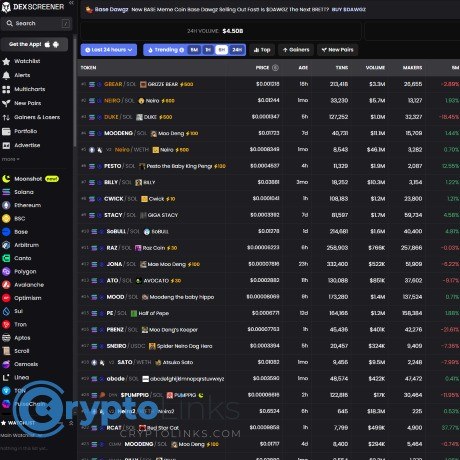
The trending and gainers views surface pairs with heavy activity, fast price moves, or rising visibility. These screens are useful for discovery because they compress thousands of live pools into a smaller set of names worth inspecting. They also attract promotional campaigns, volume programs, and short-lived launches competing for attention.
Typically, Dexscreener makes the activity visible; interpretation still comes from the numbers on the pair page. A trending pair with sustained liquidity, diverse makers, and a steady transaction feed has a different profile from one with sudden volume and a collapsing pool. The strongest use of trending pages is as a starting point for investigation, not as a ranking of asset quality.
Watchlists and alerts make fast markets easier to follow
Active DeFi markets move across many chains at once. Watchlists organize specific pairs so a user does not have to search the same contracts repeatedly. Alerts add another layer by flagging price or movement thresholds when a watched market crosses a chosen level.
This matters most for users tracking several tokens, liquidity pools, or launch candidates. Instead of keeping dozens of browser tabs open, they build a compact dashboard around the pairs that matter. Mobile access gives the same workflow a lighter form, keeping charts and notifications close when a market starts moving away from the desk.
Pair data fits token research, launches, and active trading
A researcher uses the chart to understand whether a token has real market activity. A launch team studies whether liquidity depth and swap flow support healthy discovery. An active trader watches candles, buys, sells, and market capitalization while deciding whether the current pool offers enough depth for the size of trade they are considering.
The data also helps after entry. Price alerts, volume changes, and liquidity shifts show when a market has changed character. Dexscreener is especially useful in the period before a token appears on larger listing sites, because the pool itself is already producing readable market data.
Dextools, GeckoTerminal, Birdeye, and block explorers cover adjacent needs
Dextools offers a long-running DEX analytics experience with strong EVM-chain recognition and token scoring features. GeckoTerminal focuses on broad decentralized exchange coverage and clean market aggregation from the CoinGecko ecosystem. Birdeye is especially common among Solana users who want token pages, wallet-oriented context, and ecosystem-specific discovery. Block explorers such as Etherscan and Solscan show transaction-level truth when a user needs raw contract, holder, and wallet details.
In most cases, Dexscreener remains a common first stop because its interface is quick, pair-centered, and chain-spanning. The best workflow uses charting data for market context and a block explorer when contract-level inspection matters. That combination keeps the chart readable while preserving access to the underlying on-chain record.
A grounded workflow for opening a new pair
Start with the token or pair address, confirm the chain, then inspect the main pool rather than the first matching ticker. Read liquidity before price, because shallow pools distort every candle. Next, compare volume, transaction count, and makers across time windows. Finally, scan the recent swaps panel for outsized trades, rapid back-and-forth wallet activity, or a sudden liquidity change.
After that first pass, Dexscreener becomes a monitoring surface. Add the pair to a watchlist, set alerts around meaningful levels, and revisit the transaction feed when the chart moves sharply. Low-liquidity markets punish rushed entries with slippage and violent reversals, so the page is most valuable when used before the trade rather than after the move is already obvious.
Common questions about Dexscreener
What data does Dexscreener use for live token charts?
It reads decentralized exchange pair activity from on-chain liquidity pools and turns swaps into chart candles, volume, price change, transaction feeds, liquidity figures, and maker counts. The displayed market depends on the selected pair and chain, so a token may show several pools if it trades against SOL, ETH, USDC, wrapped assets, or other quote tokens.
Does Dexscreener charge users to view charts?
The standard charting and pair discovery experience is available to ordinary users without a trading subscription. Costs enter the picture when a user leaves the chart and trades through a wallet or decentralized exchange, because blockchain network fees, pool fees, and slippage belong to the underlying chain and liquidity venue rather than the chart interface.
Can I track a token before it reaches a centralized exchange?
Yes. A token becomes visible once it has an active decentralized exchange pair that the service indexes. This is why new Solana and Ethereum ecosystem launches appear there early: the first usable market is the pool itself, not a centralized listing. Searching by mint or contract address gives the cleanest match for very new assets.
Which chains are most relevant for Dexscreener users?
Solana and Ethereum are major sources of activity, but the tool also covers many EVM and non-EVM ecosystems where decentralized exchanges run active pools. Base, BNB Chain, Arbitrum, Polygon, Avalanche, and other networks matter because traders move liquidity and new launches across multiple chains instead of staying on one settlement layer.
Is a high trending rank enough to trust a token?
No. A trending rank shows attention and trading activity, not asset quality. The stronger read comes from the pair page: liquidity depth, maker diversity, transaction history, sell pressure, and whether activity continues after the first burst. Promotional campaigns and artificial volume target discovery screens, so the rank needs context from the underlying pool data.
Do I need a wallet to use the charts?
A wallet is not required for basic chart viewing, pair search, or market discovery. A wallet becomes necessary only when you decide to interact with the market through a swap, manage a position elsewhere, or connect to a related DeFi application. Chart research and transaction inspection stay separate from wallet signing.
What happens if two pairs have the same token symbol?
The symbol alone does not identify the asset. Open the pair that matches the correct chain, contract or mint address, quote asset, and liquidity pool. Copycat tokens reuse familiar tickers constantly, so address-based search and pool inspection matter more than the name displayed on the chart header.